
We’ve sent a copy of the email to your inbox. We’ll get back to you within 24 hours.
If you have an urgent question, feel free to contact us by phone.
Office hours:
Monday to Friday
8:00 AM – 4:00 PM (CET)
Questions about products and services:

The capabilities of artificial intelligence are fascinating. At All for One Poland, we are developing solutions that harness the inherent potential of these tools to streamline and automate specific business processes. One such tool that already enables our clients to accelerate and simplify their work through the use of AI, thereby achieving measurable benefits, is the Rockawork platform, which has broad applications across various business areas.
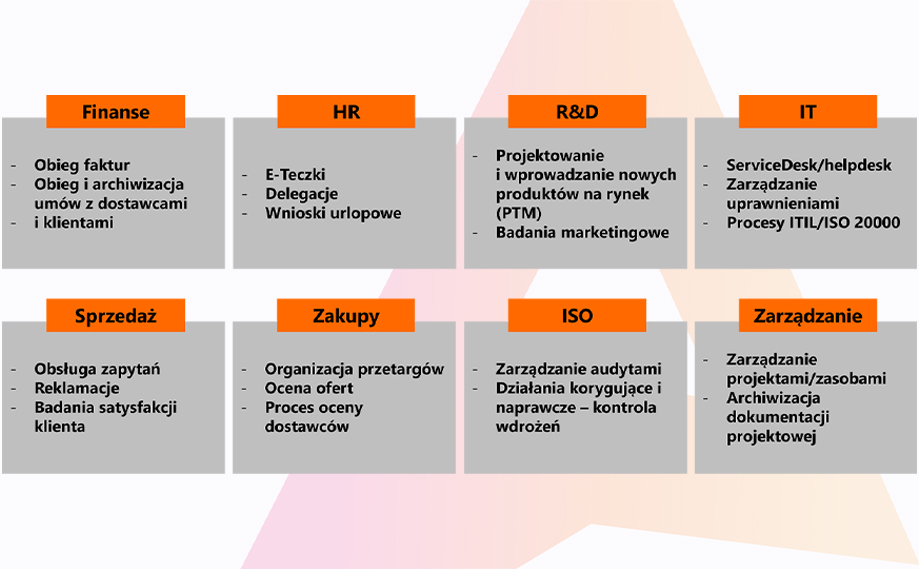
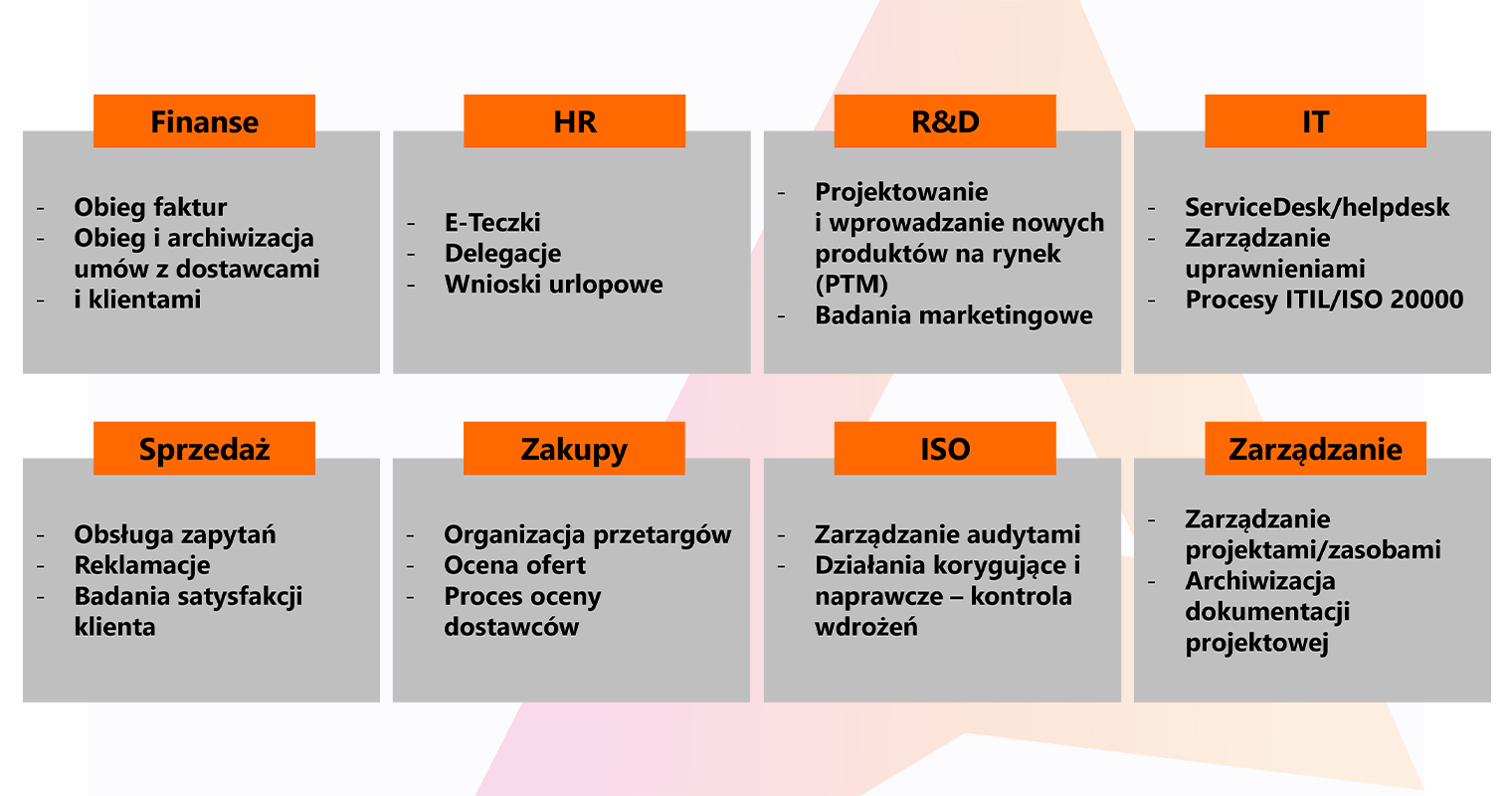
It is a low-code platform, intuitive for end-users. It allows for the creation of document schemas, process modeling in BPMN notation, report generation, and other advanced tasks. Thanks to these features and its easy adaptability, the solution is applicable across many business processes and areas.
The long-standing applications of the Rockawork platform can now be enhanced with new functionalities that significantly ease user interaction with the tool and enable the straightforward digitalization of processes that were previously impossible to automate. This is made possible by integrating artificial intelligence tools based on large language models.
The use of AI tools has been regulated by legal acts aimed at protecting people and their data. These regulations are highly significant for the use of artificial intelligence in business, and it is important to become familiar with them. In March 2024, the AI Act was adopted in the European Union, which restricts the use of artificial intelligence in several areas where it poses unacceptable risks to people. These include:
The same legal act states that the use of generative artificial intelligence, i.e., large language models (e.g., ChatGPT), is permitted. However, we must bear in mind that GDPR regulations still apply to us. This means that AI tools cannot be used if personal data is contained in documents that we intend to share with services like ChatGPT (this applies to CVs, documents exchanged with contractors, or invoices).
The solutions from All for One Poland that we present to our clients do not use language models and functionalities located outside the European Union and comply with GDPR.
The circulation and approval of purchase invoices is one of the most common applications of the Rockawork platform among our clients. In short, an invoice that has reached the company via email, scan, or in the future from KSeF, is transferred to OCR for data extraction, followed by the initiation of the approval process and posting in the ERP system.
AI solutions are applied in the approval process and communication with ERP, specifically in assigning appropriate accounts in the accounting process to invoice items, based on orders. Until recently, a common problem was discrepancies in the description of a given product on the order and on the invoice from the vendor (e.g., a black ballpoint pen on the order would become a black fineliner on the invoice) – which made automating this task practically impossible.
Implemented language models allow for matching differently named items from an invoice to order items and linking these documents in the system (in other words, AI knows that a black ballpoint pen from an order is the same as a black fineliner on an invoice). This application will support the work of accountants and free them from time-consuming review and matching of these documents.
In companies using the SAP system, similar functionality can be implemented directly within that system (MIRO transaction). A button for preliminary posting will appear on the SAP screen, requiring only verification and approval.
What if appropriate accounts required in the accounting process need to be assigned to invoice items when there are no orders or requisitions? Traditionally, in such situations, accountants usually have descriptive accounting instructions (e.g., invoices from EU countries should be posted to main account X, invoices from the USA – to account Y, from Poland – account Z). A hindrance in the digitalization of this process is the different country names used in various languages. The artificial intelligence module in Rockawork effectively handles recognizing country names in any language and correctly posting invoices. This simple example illustrates the potential inherent in AI tools.
Algorithms based on a similar principle – instructions for AI such as “always fill the main account field for invoices from company ABC with number 123”; “if… – then…”) allow for correct postings according to implemented accounting instructions. These simple natural language algorithms replace complex algorithms in traditional programming languages. At the end of the process, the employee only needs to verify correctness and approve. This represents a huge time saving in preparing and implementing automation in the invoicing process.
Another example of using artificial intelligence in ECM processes is information retrieval and leveraging knowledge accumulated within the company without the need to open and search documents. A virtual assistant independently searches documents attached to Rockawork and answers questions posed by the user in the chat window. The chat window can be added to various internal organizational pages (e.g., in the company intranet).
This functionality can be used in many different ways, for example, by helping employees search for HR information, details about offered benefits, bonus policies, or finding information contained in various types of instructions and descriptions. Such a chat can be particularly helpful for new employees during the onboarding process. They can ask the virtual assistant questions that will help them find their way in the new company – literally (“where is the cafeteria?”) and figuratively (“how do I report an absence?”, “how do I apply for funding from the social benefits fund?”). The chat conversation can be conducted similarly to interacting with a human (using context), without the need to formulate queries according to a specific schema.
In this case, the Rockawork platform can serve as a backend system, acting as a repository of documents for AI to search.
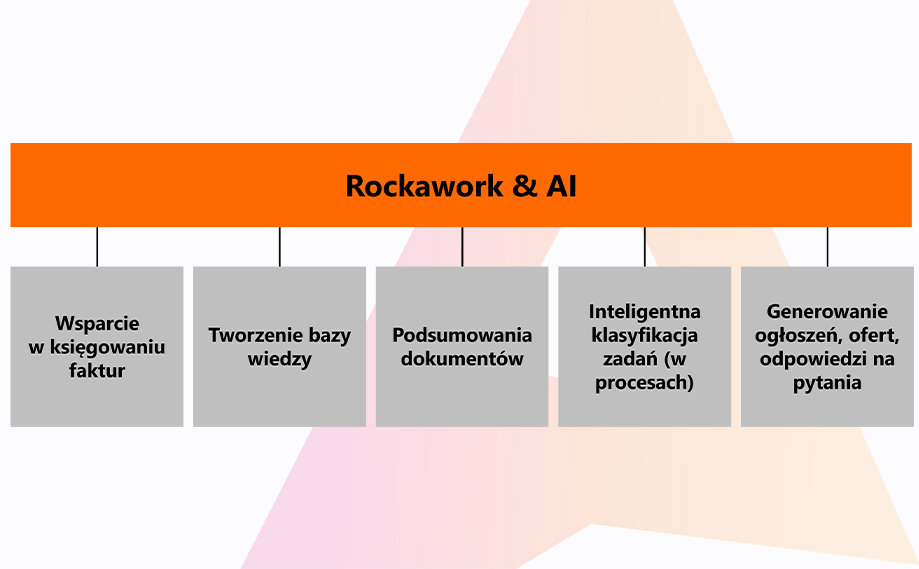
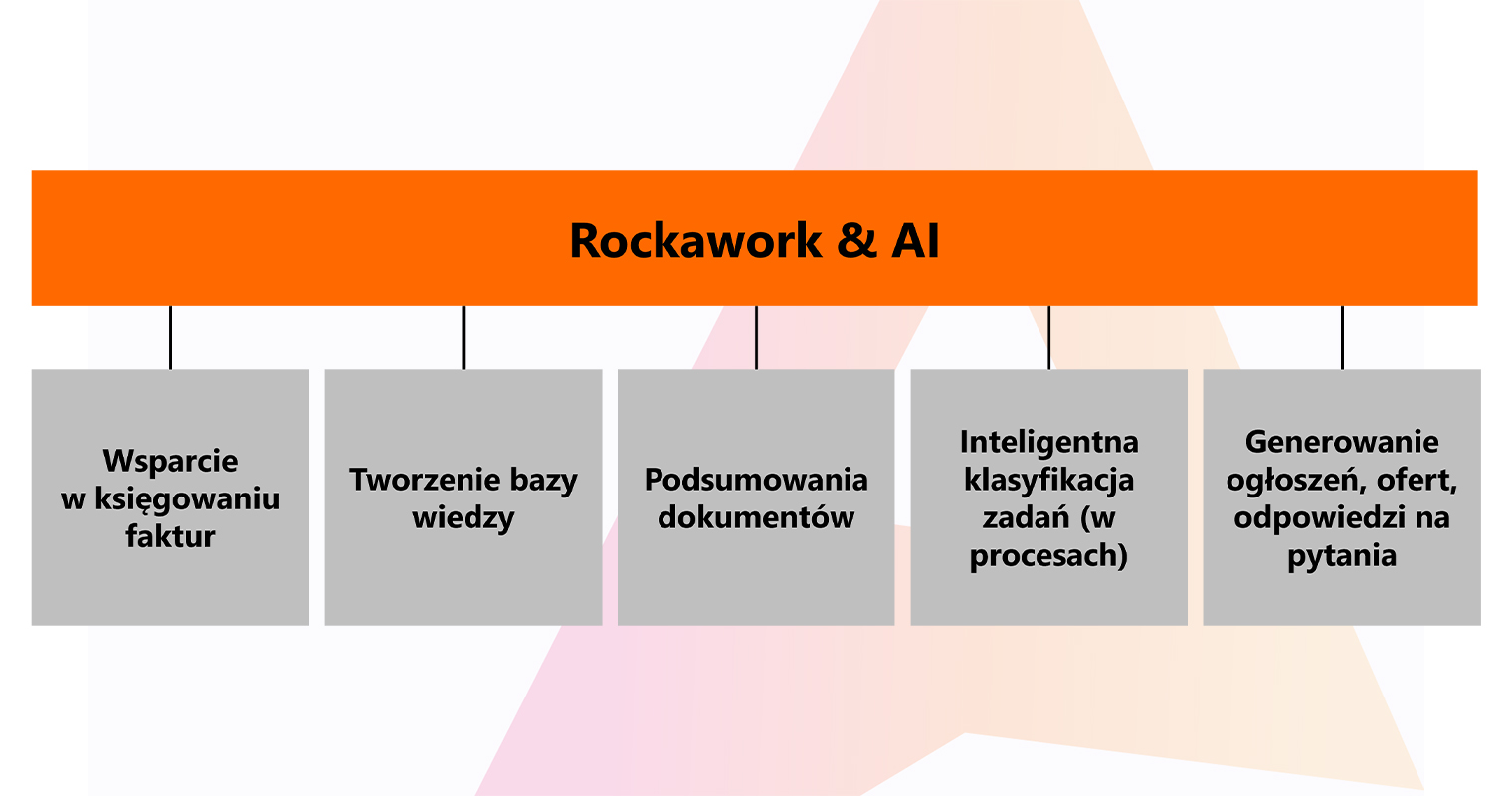
Analyzing document content according to specified parameters is also a task that AI can perform for us. A good example here is the preliminary analysis and selection of CVs submitted via email and identifying individuals who meet the specified criteria (e.g., Category B driving license, forklift operator certification, language proficiency level).
User-defined criteria are described by simple verbal commands indicating what information is important to us and how, based on which criteria, a potential evaluation should be made (e.g., foreign language proficiency level).
In most cases, AI effectively handles understanding the context and inflection of the Polish language, which not only allows it to comprehend questions well but also to provide correct, understandable answers. Offers selected in this manner proceed to further processing. And for rejected candidates, AI can help us prepare a personalized response, for example, with information about the reasons for disqualification.
The above capabilities can also be applied to analyzing documents from a contract repository (e.g., asking: “does the contract with company X contain non-compete clauses?”), providing quick assistance in operating company systems and applications (e.g., “what does it mean when a field is highlighted in yellow? And in red?”). Only our imagination limits us here.
Simple instructions for AI, such as “fill process variable ‘name’ – candidate’s first name, ‘surname’ – candidate’s last name” or “fill education variable with ‘primary’, ‘secondary’, or ‘higher'”, replacing code snippets prepared by a programmer, are a practical application of the “low-code” principle, meaning minimal coding and programmer effort in favor of flexible document schema creation and visual definition of business processes. Additionally, it is worth emphasizing that traditional code would not be able to handle many tasks of this type that require “intelligence,” contextual thinking, and association. Such developed business logic (algorithms) can be descriptively introduced into the Rockawork platform using large language models and generative artificial intelligence.
Of course, the examples of artificial intelligence applications in the Rockawork platform described above do not exhaust all the tool’s possibilities. However, they provide an idea of the scale of possible automations and facilitations that can be introduced across various organizational areas.
Time savings, employee support in performing their daily tasks or HR matters, and easy access to knowledge while ensuring compliance with legal regulations (e.g., GDPR) are the most important advantages of our solution.
Today – meeting.
In two weeks – a prototype.
Another two – launch!
Today
Our team will be happy to answer your questions.